Data Science Training in Epidemiology and Geroscience
Reproducible, robust, and secure research workflows for cohort, omics, EHR, and aging studies
My teaching and mentoring are primarily embedded in research programs, collaborative projects, and invited training contexts. I am a research scientist, so my role is not built around a conventional teaching portfolio. Instead, I focus on helping trainees build the practical infrastructure they need to do high-quality data science in epidemiology, geroscience, and population health.
Much of this work involves onboarding new students and analysts, including many international trainees, into the standard operating procedures of research data science. I teach workflows for reproducible analysis, transparent documentation, secure handling of sensitive data, version control, collaborative coding, quality control, and robust project organization.
Training Focus
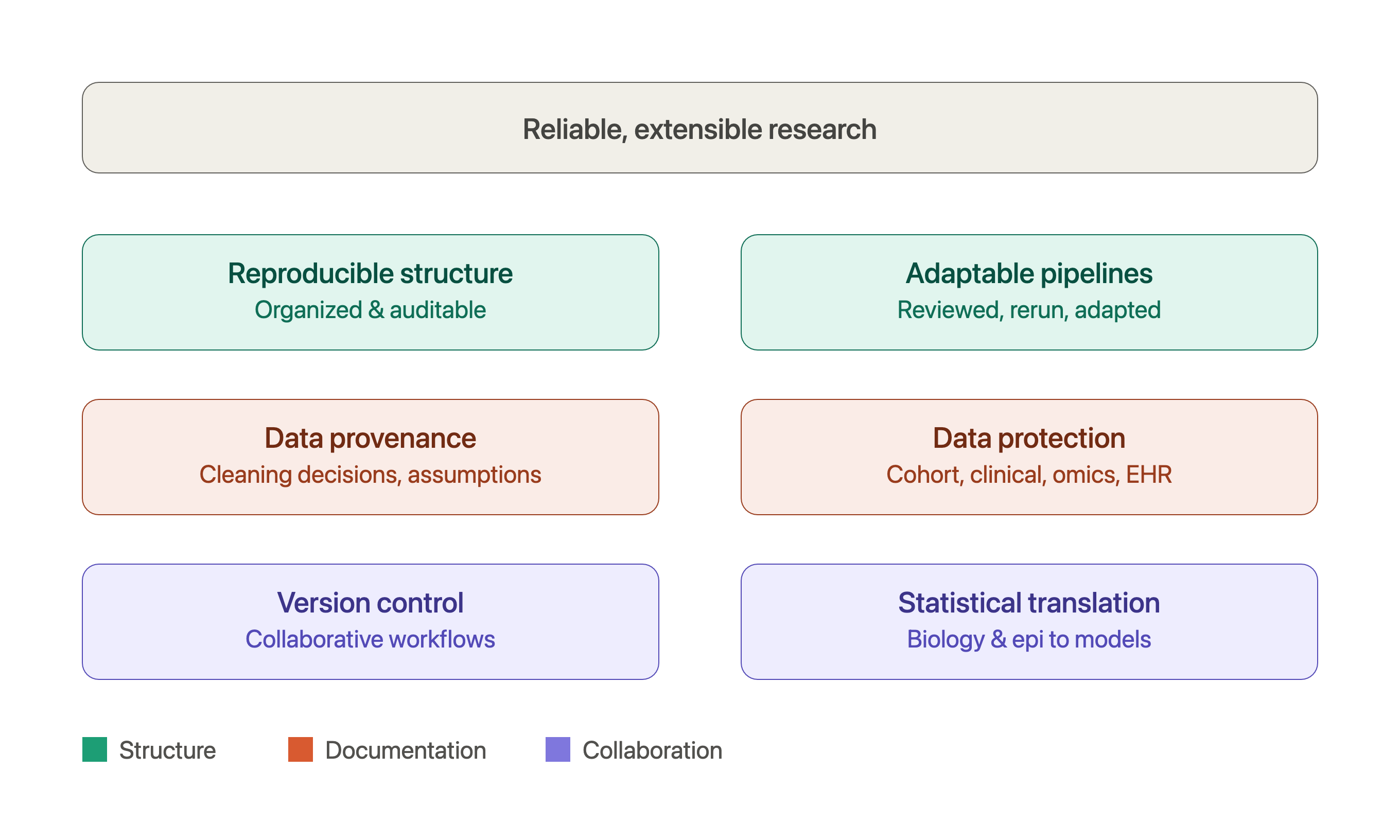
My training emphasizes habits that make research more reliable and easier to extend:
- Structuring projects so analyses are reproducible and auditable
- Documenting data provenance, cleaning decisions, and analytic assumptions
- Protecting sensitive cohort, clinical, omics, and EHR data
- Using version control and collaborative workflows effectively
- Building analysis pipelines that can be reviewed, rerun, and adapted
- Translating biological and epidemiologic questions into defensible statistical workflows
These skills are especially important in large, interdisciplinary projects where students must move between biological theory, cohort design, data management, high-dimensional molecular data, clinical records, and statistical modeling.
Invited Teaching
I also enjoy formal teaching when opportunities arise. My prior teaching includes introductory and foundational material in evolutionary medicine, aging, reproduction, stress, inequality, development, and biocultural approaches to health. Evolutionary medicine remains an important intellectual foundation for my research and mentoring, but my current teaching contribution is best understood as selective, research-embedded training rather than a stand-alone course portfolio.
